skip to main |
skip to sidebar
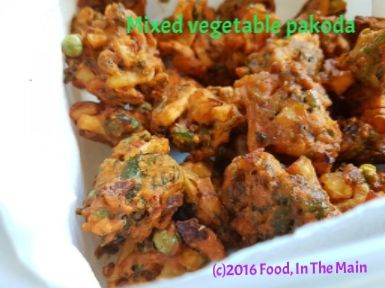
I've posted a pakoda recipe before, but I thought I'd do a post on this version because, for one, it IS slightly different and for another, I really REALLY like my photo and think it deserves to be enshrined on my blog for posterity to view over and over.
HAHAHAHA!
My mother's version (which is the only one I've used all these years) for vegetable pakoda does not involve ginger-garlic paste. This time I decided to add it, and gosh, what a difference it made to the taste! The mint also added a refreshing note. I recommend it.
Oh, and while you're considering my recommendation, make sure you guys admire my beautiful photo of the pakodas. I recommend that too.
Recipe for: Mixed vegetable pakoda
Ingredients:
1 medium potato
10-12 green beans
1/5 small cauliflower
1 medium carrot
1 cup spinach
1/4 cup green peas
1 medium onion
1 tbsp ginger-garlic paste
2 tbsp finely chopped mint
1 tsp omam/ajwain/oregano seeds
1 tsp red chilli powder
1 tsp coriander powder
1.5 - 2 cups chickpea flour
2 tbsp rava/semolina
Salt to taste
Oil for deep frying
Method:
1. Peel the carrot. Chop all the vegetables into thin 1/2-inch long strips.
2. Heat the oil in a deep wok. While the oil is heating, in a large mixing bowl, mix together all the chopped vegetables, spice powders, grated ginger and garlic, the semolina and the chickpea flour. Mix well, then add salt to taste and mix again. Add 1/4 cup water and mix with your hands to a thick dough. It should not be runny at all, because the vegetables will exude water. And once the dough is mixed, use it straightaway.
3. Drop a small piece of dough in the oil - if it floats to the top rightaway, the oil is ready. Drop the mixture carefully into the oil by the tablespoonful. Don't crowd the oil or the pakodas will not be crisp and soak up the oil. Once they are an even golden brown, remove from the oil and drain onto kitchen paper.
4. Serve warm. Great with drinks.
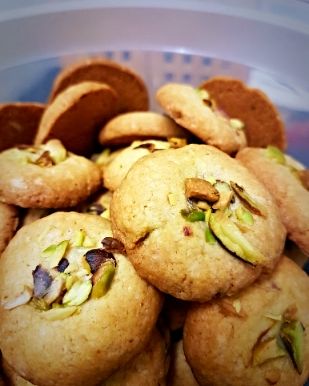
Until yesterday, I'd only ever seen nankhatai in photos on various blogs (most of them very, very beautifully shot photos, I might add). Never seen them in real life, never eaten any (not that I know of and not by that name), never baked any. Since Diwali is next week, and because I'd just bought a lovely big bag of pistachios recently, and also because our friends were going to drop by and I wanted to bake something for them with an Indian touch, I decided to make nankhatai with the pistachios and the last of my stash of saffron. The recipe I followed is on Nandita's Saffron Trail blog. My only two additions were pistachio nuts in the dough itself, and extra milk as the ghee alone was nowhere near enough to bind the mixture together to make a dough.
And what a good decision it was. I love saffron - although I don't use it often because it's expensive - and I love pistachios, and I know they're a flavour match made in heaven (fictitious place, obvs, but the match is very real and the flavours are very lovely!). These cookies are very moreish - they're not too sweet, the saffron flavour is awesome, the pistachios are delicious and the semolina gives the nankhatai a lovely crunch. Be sure to use fine semolina, though, otherwise, the nankhatai might have a sandy mouthfeel rather than crispness. Happy eating, people!
Recipe for: Kesar pista nankhatai (saffron pistachio cookies)
Ingredients:
1.5 cups plain flour
2.5 tbsp chickpea flour
1/2 tbsp fine sooji (semolina)
1/2 tsp baking soda
1/4 cup slivered pistachio nuts
2 tbsp finely chopped pistachios (optional)
1/2 cup powdered sugar
1/2 cup melted ghee (clarified butter)
1/4 tsp saffron strands, crushed in a small mortar-pestle
Milk as required
Method:
1. Preheat the oven to 180C/350F.
2. Sift together the flours, semolina and baking soda in a medium bowl. Mix in the slivered pistachio nuts and set aside. Warm 2 tbsp of the milk and let the saffron steep in it for 5 minutes.
3. In a large bowl, mix together the ghee, powdered sugar and saffron-milk until smooth, then add the flour mixture. Add extra milk a tablespoon at a time until you can form a soft dough. Be careful not to add too much liquid.
4. Roll the dough into balls the size of large marbles and place on a cookie sheet lined with non-stick paper or foil, leaving a gap of about 1.5 inches. At this point, if you wish, you can make a dimple in the centre of each cookie with your thumb and sprinkle a pinch of the chopped pistachios. If not, just flatten each ball slightly and place in the preheated oven.
5. Bake for 15-18 minutes or until the cookies are a pale brown, switching the tray around after 10 minutes so that they brown evenly.
6. Remove to a wire cooling rack. The cookies will crisp up as they cool.
7. Try not to eat all the nankhatai yourself.
I don't make sweets often, but once in a while something like Cilantro's fruit kesari catches my fancy, and then it's like a craving - so here's my craving, which I made yesterday. It's just a coincidence that it's Deepavali and the kesari is appropriate as an offering. It's even more convenient that I could use up some over-soft soft fruit that I might have thrown away if not for the craving.
Now if only someone would make me thenkuzhal and thattai...
Ah well. Happy Deepavali to everybody, and may light and happiness be ever in your lives.
Recipe for: Fresh fruit rava kesari

Ingredients:
1/2 cup rava/sooji/semolina
1-1/2 cups water
1/8 tsp saffron threads (a pinch) left to soak in 1/4 cup warm milk for 15 minutes
10-12 seedless red grapes, halved or quartered
1 small orange, peeled and segments chopped
1 small ripe banana, chopped
1 small ripe plum, stoned and chopped
1 tbsp raisins or sultanas (optional)
1/2 cup sugar
1/4 tsp cardamom powder
5 tsp ghee
2 tbsp nuts (I used walnuts and pecans)
Method:
1. Heat 2 tsp ghee in a heavy-based medium size pan and fry the rava/sooji/semolina on medium heat, stirring frequently, for about 5 minutes till the rava turns a slightly darker shade and smells roasted. Be careful that it doesn't burn. Remove to a bowl till required.
2. In the same pan, heat another tsp ghee and fry the nuts on medium heat, stirring till they are fragrant and turn a darker shade. Remove the nuts from the pan and reserve.
3. Heat the fourth tsp of ghee in the same pan, and add all the fruits, letting them cook on medium-low heat till they are soft and squishy, about 5 minutes.
4. Now add the water and sugar. Bring to a boil, then lower the heat a little and let it simmer for 5 minutes, stirring until the sugar dissolves completely.
5. Add the roasted rava/sooji/semolina now, stirring all the while to mix evenly. Let this cook until the kesari begins to thicken, then add the saffron milk and stir it in. Keep stirring frequently to ensure that it does not burn or become lumpy.
6. When the kesari is no longer watery and has "come together" in a soft mass, stir in the fried nuts along with the remaining tsp ghee. Serve the kesari warm in small bowls.
Tip: You can also spread the kesari on a greased plate and let it cool, then cut it into squares or diamonds for a more elegant (and convenient) presentation.
The most common South Indian item made with rava or semolina is upma. Upma is not my first choice of breakfast or tiffin items, as I might have mentioned before. I don’t hate it, it’s just not my first choice. If I do have it at home, I like it plain, without anything added to jazz it up - like onions or tomatoes or ginger or any other vegetables – but with sugar sprinkled on top, or on the side – I’m not fussy (oh, the irony).
But when it comes to rava kesari, I have no objections at all. A friend who knows of my tepid feelings towards upma once commented that rava kesari is just sweet upma. I’m not certain now, but I think she might have been trying to put me off my serving of kesari – too bad for her it didn’t work. There was no sharing involved from my side, I can tell you.
When I first read about pineapple kesari, a great big light bulb seemed to go off in my head, illuminating every last cobweb in there – now WHY hadn’t the idea of pineapple kesari occurred to me? Adding one of my favourite fruits to a sweet that I liked even “plain” – how perfectly delicious!
And so it was – perfectly delicious.
Note: I have to add that my kesari was a bit on the dry side (ok by me) because I skimped on the ghee – well, slightly skimped. If you, on the other hand, weigh in on the skimpy side of the scales, by all means add another generous tablespoon of the good stuff. Your pineapple kesari will not suffer for it, I assure you.
Recipe for: Pineapple rava (cream of wheat) kesari
 Ingredients:
1/2 cup rava (semolina)
 1/4 tsp saffron strands
4 tbsp warm milk
1/2 cup hot milk
1/4 cup crushed/chopped pineapple (fresh or canned)
1/4 tsp saffron strands
4 tbsp warm milk
1/2 cup hot milk
1/4 cup crushed/chopped pineapple (fresh or canned)
 1 cup water
1/4 cup sugar (or to taste)
1/8 tsp cardamom powder
4-5 cashews, broken in pieces
1 tbsp ghee
2 tbsp raisins or mixed dried berries
1 cup water
1/4 cup sugar (or to taste)
1/8 tsp cardamom powder
4-5 cashews, broken in pieces
1 tbsp ghee
2 tbsp raisins or mixed dried berries

Method:
1. Add saffron to 4 tbsp warm milk and set aside to soak.
 2. Mix the sugar, pineapple and water together and bring to a boil. Lower the heat to a simmer and leave it for 3-4 minutes while you get the rava ready.
 3. Melt the ghee in a small pan and add the cashews and raisins/berries.
 Fry on medium heat till the cashews turn golden brown and the raisins/berries puff up. Remove from pan and reserve.
 4. Toast the rava (semolina) on low heat in the same pan till it turns a darker shade and becomes aromatic.
 5. Now carefully pour the boiling pineapple mixture over the toasted rava, stirring briskly to avoid lumps forming.
 6. Stir in the hot milk as well. Cook the rava for 2-3 minutes longer, then add the ghee-fried cashews and raisins/berries. Serve hot.

RECIPE: PINEAPPLE RAVA (SEMOLINA) KESARI
Ingredients:
1/2 cup rava (semolina)
1/4 tsp saffron strands
4 tbsp warm milk
1/2 cup hot milk
1/4 cup crushed/chopped pineapple (fresh or canned)
1 cup water
1/4 cup sugar (or to taste)
1/8 tsp cardamom powder
4-5 cashews, broken in pieces
1 tbsp ghee
2 tbsp raisins or mixed dried berries
Method:
1. Add saffron to 4 tbsp warm milk and set aside to soak.
2. Mix the sugar, pineapple and water together and bring to a boil. Lower the heat to a simmer and leave it for 3-4 minutes while you get the rava ready.
3. Melt the ghee in a small pan and add the cashews and raisins/berries. Fry on medium heat till the cashews turn golden brown and the raisins/berries puff up. Remove from pan and reserve.
4. Toast the rava (semolina) on low heat in the same pan till it turns a darker shade and becomes aromatic.
5. Now carefully pour the boiling pineapple mixture over the toasted rava, stirring briskly to avoid lumps forming.
6. Stir in the hot milk as well. Cook the rava for 2-3 minutes longer, then add the ghee-fried cashews and raisins/berries. Serve hot.
I was inspired to make suji halwa when I saw Atabela's recipe for it. It seemed like such a good idea and a nice change from the usual suji halwa. A small bag of unsweetened dried berries was begging to be used, so the decision was made.
I also added some traditional sultanas and cashewnuts to the halwa, although I guess most nuts (maybe not peanuts, though) would taste just as good. Oh, and the only calories in it come from the ghee, because I used Splenda instead of sugar. There's just no way to compromise on the ghee, unfortunately, because of the flavour and aroma it imparts.

Clockwise from bottom right: Mixed dried berries (cranberries, strawberries, sour cherries and sultanas), cashewnuts, cardamom, ghee, Splenda and suji.
Suji halwa is a quick, fuss-free sweet to make - it's also homey and sort of soothing. Or maybe that's because I associate it with memories of home.
This halwa is nicest eaten hot (the microwave comes in handy here, if you're not eating it fresh). I didnt make mine the usual formless mass of halwa - I spread it on a lightly greased plate straight from the cooking pan, and cut it into squares. The berries looked like little jewels studding the little squares of halwa. They looked pretty and were the perfect size to satisfy my undemanding sweet tooth, one square at a time. And did I say they looked pretty?
Recipe for: Suji halwa with dried berries

Ingredients:
1 cup suji
3/4 cup sugar or Splenda
1/4 cup ghee
3/4 tsp cardamom powder
1/3 cup mixed dried berries and sultanas
2 cups water
Method:
1. Heat 1 tsp of the ghee in a small pan and fry the berries and nuts until the nuts turn golden. Remove from the hot pan (to stop them browning further) and reserve.
2. Melt the remaining ghee in a wide pan.

3. Add the suji to the ghee and roast it on medium-high heat, stirring frequently, until the suji starts to turn a darker colour (about 10 minutes) and gives off a nice roasting aroma.

4. The suji is done when it becomes wet-looking and the ghee begins to separate from the mixture.

5. Now is the time to add the berries and nuts, and the sugar. Stir it all into the roasted suji mix.

6. Add the cardamom powder and two cups water to the pan and stir well and frequently, making sure there are no lumps.

7. Keep stirring until the suji absorbs the water and the mixture pulls away from the sides of the pan. At this point, stirring will be difficult as the halwa will have become a soft mass. Turn off the heat. The halwa can be served rightaway in cups.
8. If you want to make serving pieces like I did, spread the hot halwa on a lightly greased flat plate, patting it down quickly and carefully with a wetted palm. Cut into pieces when it has cooled a little.
The halwa stays good for 2 days, and can be re-heated in the microwave prior to serving.
When you have a craving for dosas but no regular dosa batter with which to indulge that craving, there's a quick way of getting your fix. Granted they wont taste like "proper" dosas, but pancakes can be made with any flour and still taste pretty good.
Yesterday I opted to make rava dosas (with the addition of a little rice flour and some wheat flour). The seasoning (or tempering) for the dosas is absolutely essential, because the batter is bland and unfermented.
The rava dosas you get in hotels in India are usually wonderfully crisp and thin, an effect very likely achieved with generous slatherings of ghee or oil. But since I wasnt about to drown my dosas in oil, they turned out mostly soft, but crisp in places - absolutely yummy with coconut chutney and sambar.
Oh, by the way - you can add finely chopped onions or other quick-cooking vegetables to the batter to make the dosas more nutritious.
Recipe for: Rava dosas (cream of wheat/farina/semolina pancakes)

2 cups rava
1/2 cup rice flour
1/2 cup wheat flour (or all-purpose flour)
Salt to taste
Water as required
For tempering:
2 tsp mustard seeds
1 tsp cumin seeds
8-10 curry leaves
3-4 fresh green chillies, finely minced (according to taste)
2 tsp oil
1/4 tsp asafoetida powder (optional)
Method:
1. Use only as much water as required to make a pouring batter from the flours and salt. Set aside.
2. Heat the oil in a small pan and add the ingredients for tempering. Cover the pan and let the mustard seeds pop.
3. Pour the tempering on the batter and stir well.
4. To make the dosas, heat a non-stick tava and spread a couple of ladlefuls of batter in a swirling motion, trying to keep the dosa as thin as possible.

5. Cook on medium heat till the top dries out and the bottom part is golden, then carefully lift with a spatula and turn it over.

Let this side cook till the dosa becomes stiff. (It will soften as it cools.)
6. Serve hot with chutney and sambar.


